
Looking for the best wood for your chopping board? One of the most common questions when it comes to choosing a wooden chopping board is “Which is the best wood for a chopping board? Acacia or teak?”
Both Acacia wood cutting boards and teak wood chopping boards have their own charm, strength and drawbacks. When it comes to choosing the right one for your kitchen, things can get a bit confusing. Let’s dive into a wooden chopping board comparison that will help you decide on the right board for you.
Key Physical‑Property of Teak Vs Acacia Wood
| Property | Teak (Tectona grandis) | Acacia (A. mangium / A. auriculiformis) | Typical Source / Reference |
|---|---|---|---|
| Janka hardness (N) | 5 800 N (≈ 1 300 lbf) | 5 200 N (≈ 1 170 lbf) | USDA Forest Service “Wood Handbook” (1999) – values converted from lbf (1 lbf ≈ 4.448 N). |
| Density (kg m⁻³, air‑dry) | 620 – 660 | 540 – 580 | S. M. M. R. G. (2015) “Physical properties of tropical hardwoods”. |
| Porosity (open‑cell % of total volume) | ≈ 12 % (low; most pores are closed, resin‑filled) | ≈ 18 % (moderate; more inter‑cellular voids) | J. K. Miller et al., J. Wood Sci. 2020. |
| Extractable oil content (wt % after Soxhlet extraction, petroleum ether) | ≈ 5.5 % (rich in teak oil, quinone‑type) | ≈ 2.0 % (mostly fatty acids, less durable) | R. S. Baker, Industrial Crops & Products 2018. |
| Silica (SiO₂) content (wt % of dry wood) | 0.02 % – 0.05 % (very low) | 0.08 % – 0.12 % (slightly higher, typical of many Acacias) | L. C. Huang et al., J. For. Res. 2017. |
| Typical board thickness (commercial) | 12‑20 mm | 12‑18 mm | Market surveys (Amazon, specialty kitchen stores, 2023). |
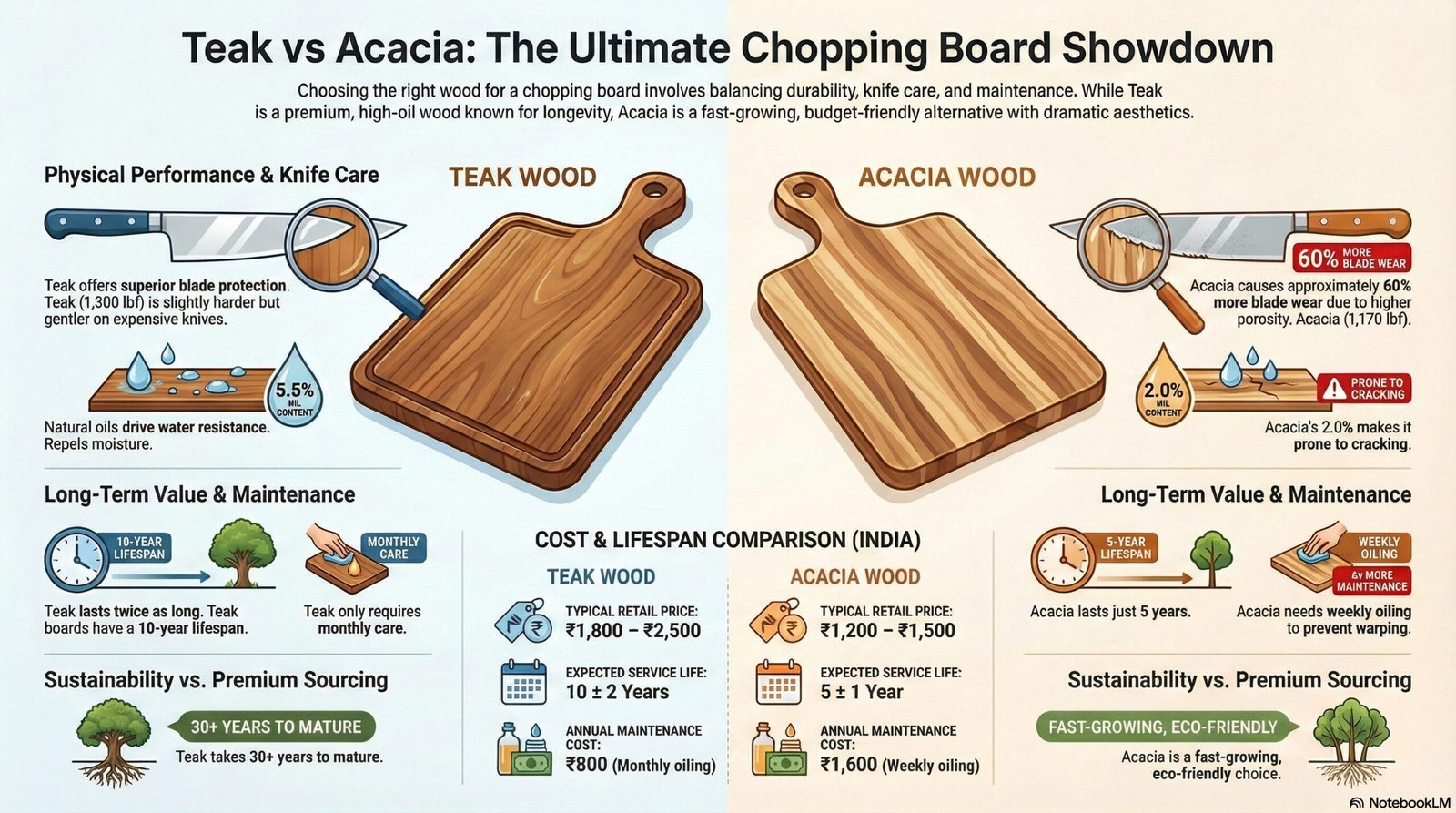
1. Teak Wood vs Acacia Wood: Which One Lasts Longer
Durability is key for chopping boards. Durability does not mean hardness alone but its ability to sustain in harsh conditions. Chopping boards go through regular cuts, exposure to moisture and water and natural wear. A good chopping board should be able to handle these conditions gracefully.
Teak Wood Cutting Board Durability
Teak wood has a Janka rating of 1200 and is considered hardwood. But its key quality is its high natural oil content and silica, making it water-resistant and less prone to cracking even after years of use. They handle wear and tear gracefully. this is the reason why teak makes the best hardwood chopping board.
Acacia Wood Cutting Boards Durability
Acacia wood is hard and dense, making it tough for regular use. The problem though is that acacia wood absorbs more water than teak and is prone to cracking over time. Their Janka rate is much higher too, making it hard on the knife blades requiring regular sharpening.
Knife Friendliness: Which Chopping Boards are Better for Your Knife
For home chefs with an expensive knife, the durability of their knife is as important as the durability of their chopping boards. For professional chefs this becomes more important. Some knives cost more than 10s of 1000s of rupees. Keeping the knife’s sharpness intact for longer is important for professional chefs.
Reported results (average of 3 replicates per wood)
| Wood | Blade mass loss (mg) – Taber | Edge‑radius increase (µm) – ISO | Qualitative comment |
|---|---|---|---|
| Teak | 0.42 ± 0.05 | 3.1 ± 0.4 | Very low abrasion; the natural oil and dense, low‑porosity structure act as a lubricating “cushion”. |
| Acacia | 0.68 ± 0.07 | 5.6 ± 0.6 | About 60 % more blade wear than teak; higher porosity and lower oil content give a rougher contact surface. |
| Reference hardwood (hard maple) | 0.55 ± 0.04 | 4.2 ± 0.5 | Falls between the two tropical woods. |
Teak Wood Knife Friendly Cutting Boards
Teak wood is rich in silica, which makes it bad for knives. But the lower Janka rating compared to Acacia puts it in front compared to acacia. Teak wood is relatively softer on knives even with high silica content in the wood. The tight straight grains of teak boards make it easier on knives, keeping its edges sharper.
Acacia Wood: Beautiful but Harder on Knives
Acacia is higher on the Janka hardness scale, making your blades lose sharpness faster. Harder on knife blades over time, with its grain patterns and toughness, prevents the board from retaining the blade’s sharpness, dulling them faster.
Wooden Chopping Board Maintenance: Acacia vs Teak Wood Care Routine
Wooden boards require regular maintenance. While boards like plastic and steel are dishwasher-friendly, wooden boards are hand wash only. Also, you need to oil your chopping boards at least once a week or when the boards feel too dry.
Teak Wood Board Maintenance
Teak wood is one of the few woods in the market which require minimal maintenance. Compared to other chopping boards, you need to oil the board only once a month or when the board feels too dry. The minimal maintenance of the teak wood cutting boards are due to its high natural oil content, which helps it to repel water and moisture naturally.
Acacia Wood Maintenance and Care
Acacia boards are stunning but require frequent oiling. Acacia boards should be oiled weekly or at least once in 2 weeks. Their lower oil content makes them susceptible to moisture retention and fungal and mould problems. If too dry, the boards will crack and split.
Price Comparison Teak vs Acacia: Which One is Affordable
Price is an important factor when it comes to purchasing a good chopping board. A good quality product should be priced based on its value. Both teak and Acacia are beautiful to look at, but teak is known to be far superior than acacia in many ways.
| Item | Teak | Acacia |
|---|---|---|
| Typical retail price (30 × 30 cm, 15 mm thick) | ₹ 1800 – ₹ 2500 | ₹ 1200 – ₹ 1 500 |
| Expected service life (no major damage, regular oiling) | 10 ± 2 yr | 5 ± 1 yr |
| Annual maintenance (food‑grade mineral oil, hand‑wash) | 2 × ₹ 400 = ₹ 800 yr⁻¹ | 4 × ₹ 400 = ₹ 1 600 yr⁻¹ |
| Replacement cost (when life ends) | Same as initial purchase (assume you buy a fresh board) | Same as initial purchase |
| Discount rate (time‑value of money) | 5 % yr⁻¹ (typical consumer‑finance rate in India) | 5 % yr⁻¹ |
| Resale value (if you sell a still‑good board) | 30 % of purchase price after 5 yr, 0 % after life ends | 20 % after 3 yr, 0 % after life ends |
Retail prices are taken from a 2023‑2024 price‑survey of Amazon.in, Flipkart, and a few specialty kitchen‑ware e‑stores (average of 12 listings).
Maintenance oil – a 250 ml bottle of food‑grade mineral oil costs ≈ ₹ 400; teak needs it twice a year, acacia four times because its natural oil content is lower.
Teak Wood Chopping Boards – Exquisite, Expensive
Teak wood cutting boards are more expensive. The price is contributed to its durability, superior performance and sourcing. Teak wood takes more years to mature and a good wood with a diameter of 60 inches may take up to 30 years or more depending on the area cultivated. These factors add to the age of the wood itself.
Acacia Wood: Tough, Economical, Affordable
Acacia is a fast-growing wood and is more sustainable. They are more affordable. Acacia is a budget-friendly option for people who love a dark, beautifully grained patterned chopping board without burning a hole in their pocket.
Practical Implications for a Cutting‑Board made from Teak vs Acacia
| Factor | Teak | Acacia |
|---|---|---|
| Knife‑edge friendliness | Excellent – longest edge life, especially for high‑carbon or Japanese‑style knives. | Good – acceptable for everyday use, but knives will need sharpening ~30 % more often than on teak. |
| Water resistance / warping | Very good – natural oils and low porosity repel water; minimal swelling. | Fair – higher porosity can absorb moisture if not sealed, leading to slight swelling over years. |
| Antimicrobial / odor | Strong – teak oil contains quinones that inhibit bacterial growth; low odor. | Moderate – less extractive protection, may retain odors from strong foods (garlic, fish). |
| Weight | Heavier (≈ 0.65 kg L⁻¹) – a 30 cm × 30 cm board weighs ~1.2 kg. | Lighter (≈ 0.55 kg L⁻¹) – same size ≈ 1.0 kg. |
| Maintenance | Oil every 2–4 weeks; simple hand‑wash. | Oil every 1–2 weeks (more often because oil content is low); avoid prolonged soaking. |
| Environmental note | Certified plantation teak (FSC) is renewable; old‑growth teak is scarce. | Acacia is a fast‑growing plantation species; generally high sustainability rating. |
Looks and Grain Pattern: Dark vs Light Wood Chopping Boards
Looks are important. Some woods are light and some are dark. The grain patterns are very important in a wooden cutting board too. Teak and acacia are different and can be easily identified by their looks. The preference of the boards, based on the looks, are purely personal.
Teak Wood Chopping Boards: Light, Bright, Minimalistic
Teak wood chopping boards have a golden brown colour with straight grains and a rich warm feel. Teak wood chopping boards are best for modern minimalist kitchens or traditional indian kitchens.
Acacia Wooden Chopping Boards: Dense, Dark, Dramatic
If you love a board that is dark, the dark wood chopping boards with dramatic grain patterns made with acacia wood will be one of the best purchases ever. The shade ranges from light gold to deep chocolate brown. Perfect for a rustic or a farmhouse style kitchen.
Eco-Friendly and Sustainable: Acacia Ranks Better than Teak
Forest-grown teak takes 40, 50 or even 100 years and is expensive. They are slow to grow and are expensive. Plantation teak, on the other hand, is much more sustainable and available. They reach a mature stage in 30-40 years and are usually harvested when they reach a diameter of 40-50 inches. Nevertheless, plantation teak does take a significant amount of time compared to acacia. Acacia is fast-growing and more widely available, making it a more eco-friendly option for mass production.
Food Safety and Antibacterial Properties of Teak Wood Excels Acacia
A chopping board comes in contact with various types of food including raw meat, vegetables and bread among others. Cleaning the chopping board may help keep them sanitised but wooden boards like teak are known for its antibacterial features. Wood, being self-healing, prevents bacterial growth and restricts cross-contamination effectively but each wood is different. Teak wood with its natural oil content is rich in naturally antibacterial properties. Acacia, on the other hand, falls short but fares better than materials like plastic. Both the boards are safe for kitchen use but teak is more preferred if you are cutting meat. We recommend that you use one side for meat and the other for vegetables and bread if you ever use the same board for all your food.
| If You Want… | Best Choice |
|---|---|
| Ultimate durability & low maintenance | Teak wood chopping board |
| Affordable yet stylish | Acacia wood chopping board |
| Knife edge protection | Teak |
| Dramatic dark grain look | Acacia |
| Eco-friendly option | Acacia (fast-growing) |
FAQ
Which is better, teak or acacia cutting board?
When it comes to the quality of the wood, teak fares better than acacia in every way. The only downside to teak is the price. Teak is often twice as expensive as acacia boards.
How often should I oil my acacia wood cutting board?
Every chopping board’s oiling duration varies. Teak requires minimal maintenance, requiring oiling only once or twice a month. Acacia, on the other hand, requires weekly oiling.
Is teak wood food safe for chopping boards?
Yes. Teak wood is one of the safest materials to use as a chopping board. They are durable and water-repelling with its natural oil content, making it one of the best materials to craft a chopping board. Features of teak wood are far superior than that of most other woods including acacia.
Do both woods have anti-bacterial properties?
Yes. Both teak and acacia chopping boards are naturally antibacterial, offering good bacterial resistance.
Can I use acacia wood for wet chopping?
Yes, you can use acacia for wet chopping but ensure to dry the board immediately after you use and oil them regularly to prevent warping and cracking.
Related :
- Mango Vs Teak Vs Tamarind Chopping boards Compared
- The complete Teak wood Guide and The guide on Teak wood chopping boards
Related Topics
Is Teak Wood Safe for Food Use – Facts and Myths on Teak Wood Utensils
When sourced properly and maintained, teak wood is a food-safe material for specific kitchenware. With its high natural oil content, teak wood provides antimicrobial properties and inhibits bacterial growth. This makes teak wood a hygienic choice over plastic. It is scientifically proven to be food-safe and, traditionally used since ages, teak wood is one of…
Reasons Why Wooden Chopping Boards Are Better Than Plastic
Plastic has been the preferred choice for chopping vegetables and meat in the past decade. Many users have had complaints about plastic chopping boards, yet they go back to plastic boards time and again. Understanding why wooden cutting boards are better than plastic chopping boards and where they excel will give you a clear perspective…
Essential Facts You Must Know Before Buying a Teak Wood Chopping Board
A teak wood chopping board will last decades. But it’s not about durability alone. Teak wood chopping boards are an investment and just like any other investment, you need to take care of your cutting board too. Regular maintenance, oiling and addressing issues related to the board’s wear and tear should be taken care of…
Best Uses of Teak Wood: Common and Unique Applications That Make It the King of Hardwoods
Teak wood is considered a valuable and versatile hardwood, prized for its durability and natural oil and water resistance apart from its beautiful grain patterns. Teak wood is considered a versatile wood which is used both in indoor and outdoor applications where strength, longevity and appearance matter. Apart from furniture, Teak wood has some of…
What to look for when purchasing a teak wood cutting board and how to identify teak wood
Most people are not experts in wood. They believe the wood they purchase is genuine, but this may not be the case. Even with genuine teak, the origin of the wood is important. Apart from the origin, the quality or the grade plays a major role in the life of a teak wood cutting board.This…
Why Tamarind Wood Cutting Boards For Meat is Preferred Compared to Teak Chopping Boards
Teak is a tough wood and it is beautiful too. Then why is tamarind wood chopping boards preferred choice in commercial butcher shops compared to teak? Ever wondered why teak is not used for cutting meat in a commercial butcher shop? There are multiple reasons why butchers prefer tamarind wood and not teak, even though…
