
The chopping board industry is a small one compared to the global kitchenware and consumer goods industry, but it’s a thriving sub-sector catering to both commercial and residential kitchens. Cutting boards are indispensable for kitchen hygiene and knife safety at home or a five-star hotel. Cutting vegetables or cutting meat, the chopping board is an essential tool for the food industry.
Global Cutting Boards Market Size and Growth Projections (2024–2034)
The market for wooden chopping boards has evolved over the years and the projections and forecasts are as below:
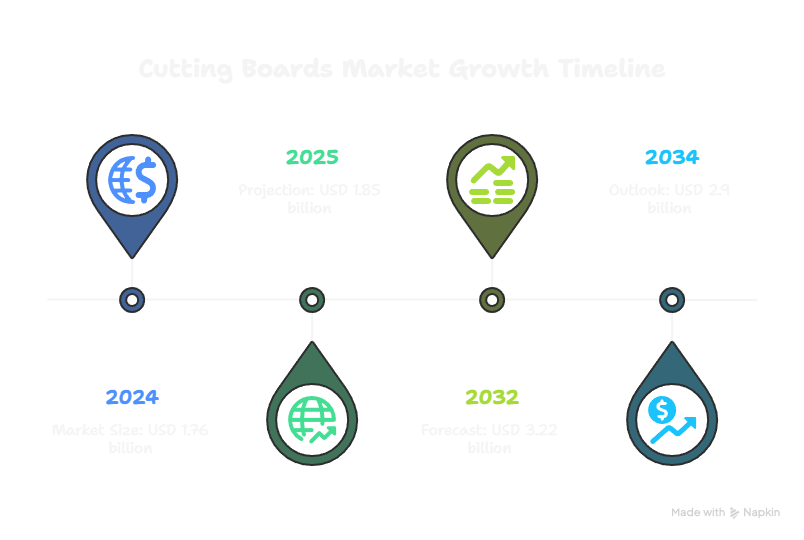
2024 Market Size: USD 1.76 billion
2025 Projection: USD 1.85 billion
2032 Forecast: USD 3.22 billion
2034 Outlook: USD 2.9 billion
CAGR (2025–2032): 6.20%
Alternate CAGR (2025–2034): 5.16%
The figures are a strong indication of an upward momentum for premium sustainable and multifunctional chopping boards in both emerging and mature markets.
Cutting Boards Market Segmentation by Material Type (2023–2025)
Over the years, consumers have been very conscious of their choice of cutting boards based on material and styles. The features like knife friendliness, durability, sanitization, and aesthetic kitchen designs play a major role in the choice of cutting boards when it comes to consumers. Chopping board material plays a major role as far as features are considered. The materials used and their market along with people’s choice are detailed below:
1. Wooden cutting boards:
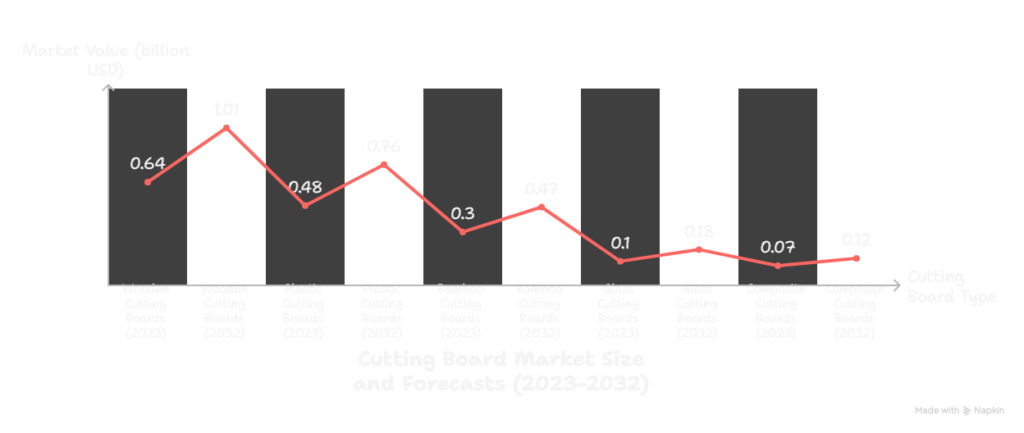
Wooden cutting boards are the most preferred choice for home cooks and professionals. Valued at 0.64 billion in 2023, the market is expected to grow a whopping 1.04 billion by 2032. That’s nearly double in 9 years. The variety of wood, the construction type, and designs play a major role in the choice of customers. Teak wood chopping boards and tamarind cutting boards are always trending and are considered the best wooden cutting boards for chefs. Sustainable hardwood chopping boards are making a comeback among eco-friendly consumers. Other features which make wooden chopping boards more trendy include the antibacterial features, long-lasting durability, and knife friendliness.
2. Plastic chopping boards:
Though plastic chopping boards were generally seen as inferior, the affordability of plastic chopping boards makes it easily accessible. The market for plastic chopping boards in 2023 was valued at 0.48 billion and is expected to grow to 0.76 billion dollars by 2032. Other features which drive the growth of plastic chopping boards include their hygienic features, dishwasher safety, and antibacterial protection, especially when they are new and without scratches and grooves. Being non-porous, plastic boards are the standard in commercial kitchens and as it’s more affordable, more home kitchens prefer a plastic board to other materials even with their drawbacks.
3. Bamboo cutting boards – Rising eco-friendly star:
The bamboo board is relatively new and became commercial very late in the late 1900s or 2000s. Though a late entry, the bamboo boards have a considerable market with over 0.3 billion in 2023 and are expected to grow to 0.47 billion dollars by 2032. Bamboo is often considered a replacement for wooden chopping boards. Relatively cheap, easy to handle, and eco-friendly, bamboo chopping boards will see a small rise in its market share over the decade.
4. Glass cutting boards:
Glass cutting boards are relatively new and made an entry only as a decorative addition to most kitchens. Not very knife friendly and a bit difficult to handle, glass chopping boards are an emerging product in the industry. With just a 0.1 billion dollar market share in 2023, it is expected to grow to 0.18 billion by 2032. Though not a significant growth in terms of numbers, it’s a near 100% growth in a decade. The use of tempered glass cutting boards and decorative glass kitchen boards will see a small market growth in the decade.
5. Composite cutting boards – Emerging in commercial kitchens:
New boards like Richlite composite boards, rubber boards, Epicurean kitchen boards, and Sani-Tuff rubber cutting boards have made a significant impact in the chopping board market and are expected to grow over the decade. Valued at 0.07 billion dollars in 2023, the growth to 0.12 billion by 2032 is projected by various businesses and reviews.
Materials like rubber, metal, silicone are emerging and are seen as preferred by professionals in the food preparation businesses.
Regional Market Insights and Top Markets for Cutting Boards in 2025
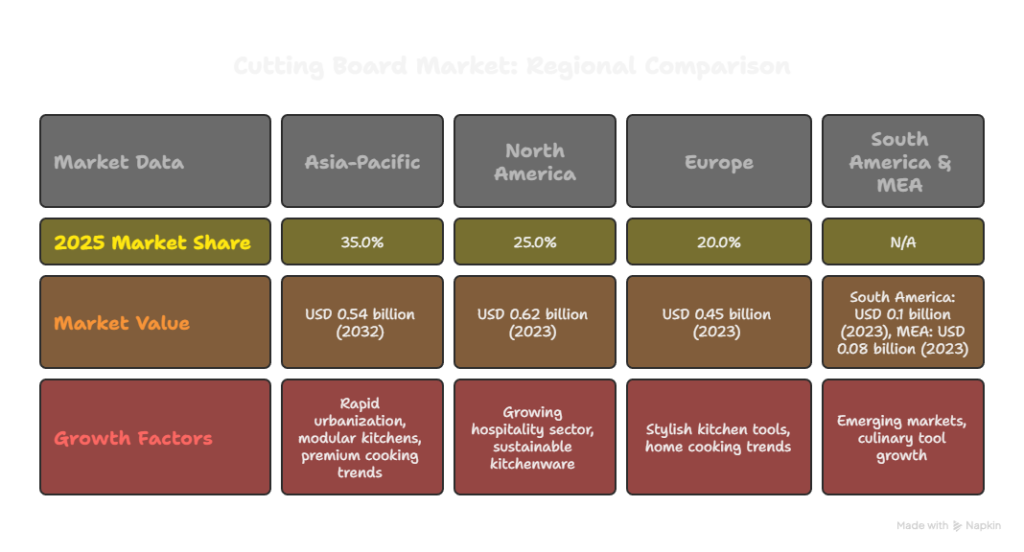
One of the biggest markets for chopping boards in the world is the Asia-Pacific region. The total market is approximately 35% and is valued to be approximately 0.54 billion in 2023. The rapid urbanisation and move over to modular kitchens is seeing the growth of premium cooking trends in the market.
United States and North American market is dominated by USA and China. The total market share is approximately 25% and is valued at 0.62 billion in the year 2023. This is primarily focused on the hospitality sector with focus on sustainable kitchenware.
The European market holds a strong demand for designer and co-boards with a market share of 20% or 0.45 billion USD. The preference is more inclined towards stylish minimal kitchen tools and the growing home cooking trends.
Other markets include South America, Middle East, and Africa with an approximate 0.19 billion dollar market and is an emerging market with a potential for culinary tools and accessories.
What Drives the Market and Why Cutting Boards Are in High Demand
The rise in demand for cutting boards is due to various factors and not just one. From people who are looking for pretty chopping boards for Instagram videos to others who are looking for a hygienic board, the consumers are becoming more aware of their needs. The specifications are not just limited to material but also designs. New innovative designs are trending and with eCommerce expansion, people find that chopping boards of a wider variety are available now at their doorstep.
Major contributors to the growth and demand of chopping boards are attributed to the below factors:
1. Boom in commercial kitchen:
Hotels, restaurants, and cafes are fuelling the demand for heavy-duty professional-grade cutting boards. New restaurants or old ones, chopping boards are a continuous requirement for commercial kitchens. Chopping boards require replacement every 3 months in a busy kitchen and even a slow-moving restaurant will be forced to change their boards once or twice a year. With more and more restaurants and cafes emerging, the need for commercial chopping boards is not a surprise.
2. Modular kitchen trends:
Modular kitchens with a dedicated chopping area are not new. With more and more modular kitchens being built with built-in chopping areas, the push for sales of custom-sized wooden boards is emerging. More and more kitchens are looking for custom-sized chopping boards which are not possible with steel, glass, and plastic. Composite boards and wooden boards have an advantage with the handcrafted products. Wooden chopping boards with custom sizes and designs, perfectly crafted for your kitchen and home, are trending because of the modular kitchen designs.
3. eCommerce expansion:
Gone are the days when you had to rely on local products. Today you can get a product from across the world with ease. Websites like Amazon and Flipkart make it possible to acquire products for your home from the most remote part of the country. Businesses like Amra Farms, Woodchop, and Vesta Homes are able to deliver their products from remote parts of the country to cosmopolitan and metropolitan cities with ease. The emergence of eCommerce has made it possible to acquire the best variety of teak wood chopping boards, Acacia wooden boards, and tamarind wooden boards from areas where it’s widely available to parts that are not.
4. Home cooking craze:
Social media like Instagram, Facebook, and Pinterest combined with food influencers and shows are driving more sales not only among social media influencers themselves but among home users too. Buying Instagram-worthy and functional cutting boards is common among food influencers but people who view these boards are also buyers of custom-designed wooden chopping boards in most cases.
5. Focus on food hygiene:
Today’s consumers are more conscious about their purchase. A non-toxic antimicrobial board is often a primary consideration apart from aesthetics. Some users are looking for dishwasher-safe chopping boards while others are looking for a sustainable option which is antimicrobial. With more awareness, people are moving to wooden chopping boards and stainless steel options which suit their needs. Today, it is not very hard to acquire products which are not available locally.
Emerging Market Opportunities in the Cutting Boards Industry
Today’s market is moving towards more tailored solutions. More and more vendors are focused on creating custom chopping boards for meat, pastry, or just vegetable preps. Features like juice grooves, anti-slip grip, and built-in knife sharpeners are becoming increasingly popular. Designer cutting boards with collaborations with celebrities and influencers are also making it big. Co-branded launches with chefs like Ranveer Brar, Kunal Kapoor, and local chefs like Chef Pillai target millennial buyers with YouTube videos and Instagram reels. While the hype is on one side, the other set of people are looking for biodegradable chopping boards from reclaimed wood for a zero-waste kitchen tool. It’s not just a hype for them but an eco-friendly movement. Multifunctional tools like a combination of cutting board with a serving tray, a board with knife blocks, or a chopping board which doubles as a snack platter is also seeing significant growth. Smart cutting boards with weight scales are already a popular option in countries like Japan and Korea. Integrated with apps and timers, tech-savvy home chefs now have advanced features on chopping boards which may see an entry into the global market soon.
Market Challenges and Volatility
With new growing alternatives, people are often experimenting with built-in kitchen chopping board units and flexible silicone mats to compete with traditional boards. This creates a challenge in the existing market for established products. The lack of raw material, especially in the wooden sector, is also a major problem. People who are looking for sustainable options may find their product of choice unavailable when ready to purchase. The growing toxic plastic concerns and low-grade boards with BPA and phthalates pose a health hazard, and a wooden chopping board’s unavailability is challenged with eco-friendliness, sustainability, and unavailability due to weather, climatic conditions, and inability to procure raw material.
Market Trends to Watch Out
Every year we see new innovations — some are short-lived while others tend to become mature and a standard after a while. It’s hard to say which of them will be a clear winner, but here are some trends which are seen this year in the chopping boards market:
1. Multipurpose kitchen tools:
Watch out for convertible chopping stations and boards that double as trays. There will be a lot of innovative designs which will be marketed as chopping boards but will double as trays, and there will be convertible chopping stations which are innovative and creative, especially in the commercial sector.
2. Composite innovation:
We have already accepted composite products like Richlite and Epicurean boards in the food service setup. This will be more prominent in the short span. Some of them will also be seen as a new standard while others will disappear due to cost concerns, marketability, or poor acceptance from customers.
3. Eco-conscious designs:
While bamboo boards are already mainstream, recycled plastic is catching up fast too. Look out for new variations in bamboo and recycled plastic boards for the eco-conscious consumers.
4. Tech-infused boards:
This may not be very popular yet, but it is soon going to catch up. Though the consumer base for tech-infused chopping boards is limited, smart boards with weighing ingredients may soon become a trend, influenced by social media and other marketing platforms.
5. Minimalist design influence:
Many homes are moving towards a minimalist approach, and this may be reflected in chopping boards too. Check out designs that are minimalist and align with home design. Boards with no grooves, simple sleek design are possibly going to make a good market share.
Top Cutting Board Brands Shaping the Global Market
While advertised as global brands, most chopping board manufacturers are not truly global. Boards like John Boos have a good presence in the USA but very limited penetration outside the USA. Boards in India are poorly advertised, even though some of the brands are excellent in terms of quality, often excelling those of international brands. The most common international brands internationally and their USP are as below:
1. Epicurean:
Epicurean boards are recycled paper composite boards. Though new, they are making a great impact in the market with their new approach.
2. John Boos:
Boos Block is a brand name which is the first thing that comes into people’s mind. A brand known for its end grain chopping boards, Boos is one of the long-standing companies in the chopping board business. Though they claim to have an international presence, their products are available only in parts of Europe and the USA.
3. Proteak:
A company that deals with only Teak wood chopping board.
Other brands that are well-known are Edward Wohl, for their handcrafted boards, Neoflam for their antibacterial cutting boards. In India, the top brands are Amra Farms, Woodchop, Old Trunk, and Chefbæ.
Related Topics
Is Teak Wood Safe for Food Use – Facts and Myths on Teak Wood Utensils
When sourced properly and maintained, teak wood is a food-safe material for specific kitchenware. With its high natural oil content, teak wood provides antimicrobial properties and inhibits bacterial growth. This makes teak wood a hygienic choice over plastic. It is scientifically proven to be food-safe and, traditionally used since ages, teak wood is one of…
Reasons Why Wooden Chopping Boards Are Better Than Plastic
Plastic has been the preferred choice for chopping vegetables and meat in the past decade. Many users have had complaints about plastic chopping boards, yet they go back to plastic boards time and again. Understanding why wooden boards are better than chopping boards and where they excel will give you a clear perspective on both…
Essential Facts You Must Know Before Buying a Teak Wood Chopping Board
A teak wood chopping board will last decades. But it’s not about durability alone. Teak wood chopping boards are an investment and just like any other investment, you need to take care of your cutting board too. Regular maintenance, oiling and addressing issues related to the board’s wear and tear should be taken care of…
Best Uses of Teak Wood: Common and Unique Applications That Make It the King of Hardwoods
Teak wood is considered a valuable and versatile hardwood, prized for its durability and natural oil and water resistance apart from its beautiful grain patterns. Teak wood is considered a versatile wood which is used both in indoor and outdoor applications where strength, longevity and appearance matter. Apart from furniture, Teak wood has some of…
What to look for when purchasing a teak wood cutting board and how to identify teak wood
Most people are not experts in wood. They believe the wood they purchase is genuine, but this may not be the case. Even with genuine teak, the origin of the wood is important. Apart from the origin, the quality or the grade plays a major role in the life of a teak wood cutting board.This…
Wooden chopping boards that naturally resist fungus/mold growth
Purchasing a wooden chopping board goes beyond aesthetics and durability. When considering a chopping board, most of us overlook common factors including toxicity, food safety, and performance. As a home cook, we understand the importance of a chopping board, but when it comes to purchase decisions we end up buying something based on our budget.…
The worst material for Vegetable Cutting boards
There are a lot of recommendations for Vegetable cutting boards but do you know what materials you shouldn’t choose for vegetable cutting boards? Over the years we have seen a lot of material in the chopping board industry. We have moved from traditional wooden chopping boards to mostly plastic. But other materials have evolved over…
Why Tamarind Wood Cutting Boards For Meat is Preferred Compared to Teak Chopping Boards
Teak is a tough wood and it is beautiful too. Then why is tamarind wood chopping boards preferred choice in commercial butcher shops compared to teak? Ever wondered why teak is not used for cutting meat in a commercial butcher shop? There are multiple reasons why butchers prefer tamarind wood and not teak, even though…
